

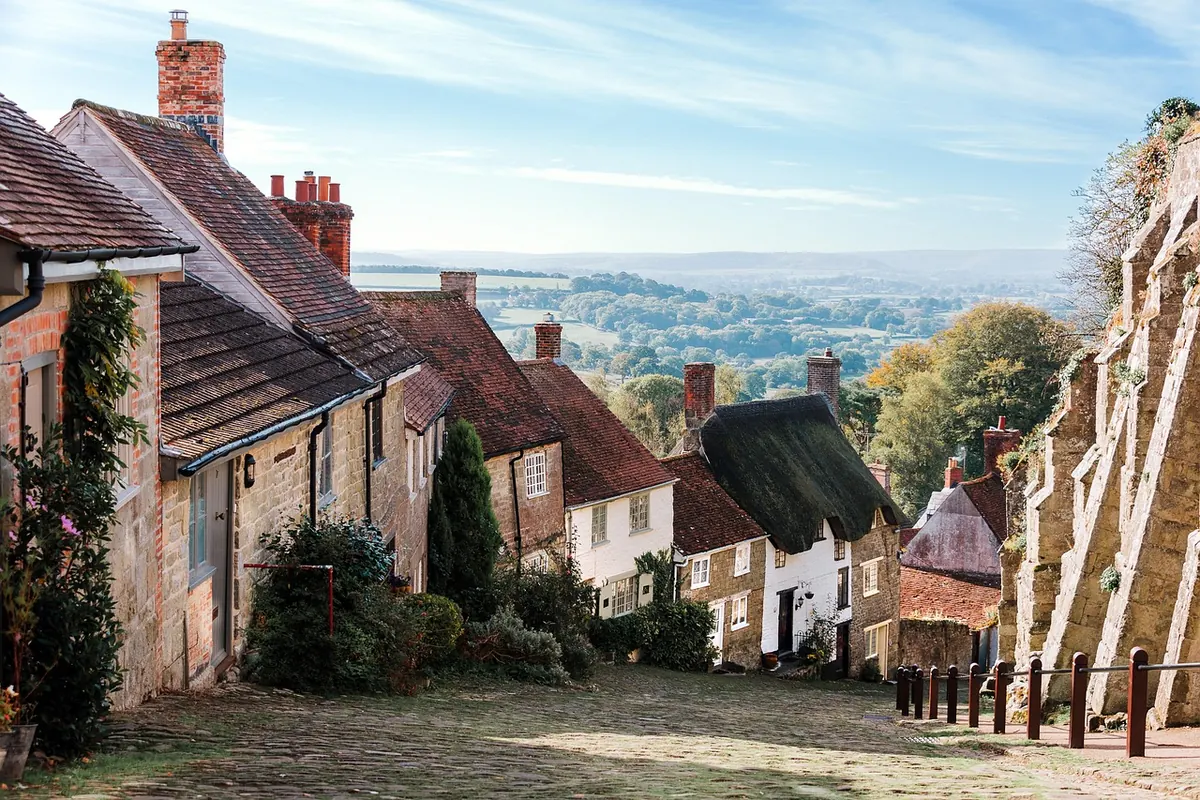



The duck pond. The vicar on a bicycle. The pub where conversation stops when a stranger walks in. These aren’t bad details — plenty of real villages have three of them. The trouble is that they arrive so readily that they stop doing any work. A reader skims past them and learns nothing about the place, and nothing about the people in it. Cliché in village fiction is rarely about inaccuracy. It’s about a setting that exists to be charming rather than to be lived in.
The postcard problem
The fix isn’t to strip the charm out. It’s to build a village with an economy, a weather pattern and an argument. Before you write a scene, answer three questions: where does the money come from, how does anyone without a car get to work, and what has the parish council been shouting about since March?
If you can’t answer those, you’re writing a backdrop. Villages aren’t small towns with the shops removed. They’re places with a specific relationship to distance, to land, and to the handful of families whose names are on the war memorial and still on the electoral roll.
Research the place, not the idea of the place
Good research is mostly dull paperwork, and it’s the quickest route to authenticity. Start here:
- Parish council minutes. Posted online or pinned to a noticeboard. Planning objections, grass-cutting contracts, the state of the bus shelter. This is village politics in the raw.
- The local authority’s planning portal. Search an address and see what’s been applied for, refused and appealed. Granny flats, barn conversions, and a startlingly bitter row about a fence.
- Historic England listings (and their equivalents in Scotland and Wales). The description of a listed building tells you what it was built as, not just what it looks like now.
- Old Ordnance Survey maps. The National Library of Scotland’s collection is free to browse. Compare 1890 with 1960 with now: you’ll watch the railway go and the estate arrive.
- Local newspaper archives. Council meetings and court reports give you names, trades and turns of phrase.
- The parish magazine, the churchyard and the village Facebook group. Between them: births, deaths, lost cats, and the true temperature of the place.
Two hours in a planning portal will teach you more than a week of mood boards.
Get the geography right
Villages have shapes, and the shape decides how a story moves. A nucleated village — church, pub and a cluster of houses around a crossroads — behaves differently from the scattered settlements common in parts of the South West, Wales and Scotland, where the parish covers a spread of farms and the centre is one building and a phone box.
Before you write a single walk, know the distance from the new estate to the school, which road has no pavement, where the footpath crosses the field, and what sits at the edge of the village — because something always does. A bypass, a quarry, a business park, a sewage works, a golf course. Use Street View to check gradients and hedges. Everything is uphill in the rain.
Money, buses and grudges
Village life is shaped by three unglamorous things.
Housing
Who can afford to live there, and where do their children go when they can’t? Second homes and holiday lets leave windows dark in February and make the shop’s winter takings unpredictable. Don’t state the politics; show the consequences — the year-round residents, the seasonal ones, the ones who grew up there and now commute an hour each way.
Transport
Know the timetable. Whether the bus runs twice a day or not at all changes who your characters can meet, how they get to a hospital appointment, and what a taxi home from the pub costs. Detail of this kind does more for atmosphere than any amount of honeysuckle.
Grudges
Every village has a live dispute. A footpath, a boundary hedge, a barn conversion, an allotment waiting list, a speed limit. These arguments are small in scale and enormous in feeling, which is exactly what fiction wants.
Voices and names
Resist dialect pastiche. Rendering an accent phonetically — ooh-arr, dropped g’s — usually reads as condescension and slows the reader down. Rural speech in Britain is often understated, indirect and full of shared reference; people don’t explain what they both already know. Let a character say, “I heard about the fence,” and let the reader work out the rest.
Names matter too. Check that a surname is plausible for the county, and that the village name doesn’t sound invented by a tourist board. Real names come in layers: a Norman church, a Victorian chapel, a 1970s cul-de-sac named after the field it was built on.
What actually happens in a village
The default plot is a body in the duck pond. It works, but it’s crowded. Other things happen: a farm sold to a developer, a flood that wrecks an insurance quote, a shop closing and the parish trying to buy it, a boundary change nobody wanted, an adult returning to clear a parent’s house, a footpath closed for a fortnight and reopened as a private drive.
Pick a change, not a crime. A village under pressure from one specific thing will generate scenes for you, because everyone reacts differently to it and nobody can avoid it.
A method you can use this week
Here’s a process that turns research into pages.
- Fix a real location and a decade before you write anything. Vagueness reads as nostalgia.
- Read three primary sources about that place: minutes, a pair of maps, a newspaper archive.
- Write ten facts about your village that could only be true of that village. If a fact would work anywhere, cut it.
- Name one thing that is changing and one thing that refuses to.
- Give the village one working institution — pub, chapel, shop, sports club — and one grievance.
- Cut every detail you can’t justify. Charm is a by-product of precision.
Do that and you’ll have a setting that reads less like a postcard and more like somewhere with a bus timetable, a leaking roof and a row about a hedge. That’s the village a reader will believe in.
Photo: Bittermuir / Pixabay